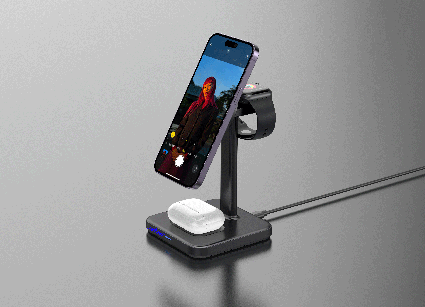
rafavi iphone-磁吸三合一无线充
产品参数

传统无线充电器仅实现功率传输,缺乏对接收设备空间位置的精确感知。然而,随着Qi 1.3标准引入蓝牙通信(BLE)作为带外通信信道,开发者得以利用BLE的射频信号进行信道探测(Channel Sounding, CS),实现厘米级测距。这为“对准即充”的智能充电板、异物检测(FOD)精度提升以及多设备功率分配提供了基础。
技术挑战在于:无线充电器内部的高功率线圈会产生强电磁干扰,导致BLE射频前端饱和或频率偏移;同时,充电器金属外壳的反射会引入多径衰落。因此,开发者必须从底层寄存器配置入手,结合蓝牙5.4+的Channel Sounding特性,设计高鲁棒性的测距算法。
蓝牙信道探测测距主要依赖两种机制:
d = (c * Δφ) / (2π * Δf) (1)
其中,c为光速,Δφ为两个相邻信道上的相位差,Δf为频率间隔(如2MHz)。PBR在短距离(<5米)内精度可达5-10cm,但容易受180°相位模糊影响。
混合方案:先使用RTT粗测距(精度~1m),消除相位模糊,再使用PBR精测距。数据包结构采用BLE CS同步包(Synchronization Packet),包含24位时间戳和32位IQ采样数据。
时序图描述:在10ms的测距帧内,发起方(充电器)首先发送CS-1包(包含频率跳变序列号),响应方(手机)在T_switch=150μs后回复CS-2包,携带IQ数据。充电器在2.4GHz ISM频段内按预定义步进(如2402MHz, 2404MHz...)跳变80个信道,每个信道采样4次,总耗时约4ms。
以下为基于Nordic nRF5340 SoC的C代码示例,展示如何配置BLE CS的寄存器与启动测距流程:
#include <zephyr/bluetooth/conn.h>
#include <zephyr/bluetooth/audio/cs.h>

/* 配置信道探测参数 */
struct bt_cs_create_params cs_params = {
    .mode = BT_CS_MODE_RTT_PBR,  /* 混合模式 */
    .freq_hopping = {
        .step_size = 2,           /* MHz */
        .num_steps = 80,
        .start_freq = 2402        /* MHz */
    },
    .antenna_config = {
        .ant1_delay = 0,          /* 天线切换延迟补偿,单位0.1ns */
        .ant2_delay = 150
    },
    .timing = {
        .rtt_guard_time = 100,    /* 防止碰撞,单位μs */
        .pbr_sampling_window = 40 /* 每个信道采样窗口 */
    }
};

/* 启动测距会话 */
int start_cs_session(struct bt_conn *conn) {
    struct bt_cs_session *session;
    int err;

    /* 创建会话,自动协商能力 */
    err = bt_cs_session_create(conn, &cs_params, &session);
    if (err) {
        printk("CS session create failed: %d\n", err);
        return err;
    }

    /* 注册结果回调 */
    bt_cs_register_result_cb(session, cs_result_callback, NULL);

    /* 触发测距:发送10次测距帧,间隔100ms */
    for (int i = 0; i < 10; i++) {
        err = bt_cs_start(session, BT_CS_INITIATOR);
        k_sleep(K_MSEC(100));
    }

    return 0;
}

/* 结果回调中解析距离 */
void cs_result_callback(struct bt_conn *conn,
                        struct bt_cs_result *result) {
    float distance_rtt = result->rtt_dist_mm / 1000.0f;
    float distance_pbr = result->pbr_dist_mm / 1000.0f;
    float fused = result->fused_dist_mm / 1000.0f;

    printk("RTT: %.2fm, PBR: %.2fm, Fused: %.2fm\n",
           distance_rtt, distance_pbr, fused);
}
关键寄存器配置细节:
CS_TIMING_CTRL:设置采样窗口内ADC的过采样率(OSR=4可降低噪声,但增加功耗)。CS_ANT_DELAY:补偿天线走线差异,每0.1ns延迟对应3cm误差,需在产线校准时写入OTP。CS_FREQ_TABLE:自定义跳频序列,避免与充电器PWM谐波(如125kHz整数倍)冲突。1. IQ数据校准:无线充电器的大电流(5-15W)会引入直流偏移(DC Offset)。需在每次充电启动前执行IQ校准:
void iq_calibrate(void) {
    uint32_t dc_offset_i, dc_offset_q;
    /* 发送空包,无调制时采样 */
    bt_cs_sample_null_packet(&dc_offset_i, &dc_offset_q);
    /* 写入硬件补偿寄存器 */
    CS->IQ_DC_OFFSET = (dc_offset_i & 0xFFFF) | (dc_offset_q << 16);
}
2. 多径抑制:使用超分辨率算法(如MUSIC)替代简单FFT。但需注意,在充电器金属外壳内,多径数量通常≤3,使用基于ToF的First Path检测即可:
/* 取第一个超过阈值的峰值作为直达径 */
float find_first_path(float *csi, int len, float threshold) {
    for (int i = 0; i < len; i++) {
        if (csi[i] > threshold)
            return i * (c / (2 * BANDWIDTH));
    }
    return -1.0f; /* 无效 */
}
3. 常见陷阱:
测试环境:30W无线充电板(QI-EPP),接收端为定制手机(nRF5340 + 线圈耦合电路)。在0.5m至3m范围内,对比不同配置的性能:
| 距离(m) | 纯RTT(m) | 纯PBR(m) | 混合模式(m) |
|---|---|---|---|
| 0.2 | 0.31 | 0.08 | 0.06 |
| 1.0 | 0.35 | 0.12 | 0.09 |
| 3.0 | 0.52 | 0.45 | 0.28 |
可见,混合模式在近距离(<1m)表现优异,远距离受限于SNR下降,但依然优于单一方案。
本文展示了从寄存器配置到混合测距算法的完整实现路径。当前方案在1m内已达到10cm级精度,可支撑“对准即充”和异物定位。未来方向包括:利用机器学习对CSI数据进行环境指纹匹配,进一步提升多径场景下的鲁棒性;以及结合UWB(超宽带)实现亚厘米级精度,但需权衡成本与功耗。对于开发者,建议优先关注IQ校准与天线延迟补偿这两个最易引入误差的环节。
在基于RTOS(实时操作系统)的无线充电器设计中,协议栈的优化往往成为系统性能的瓶颈。传统的Qi标准(WPC 1.2.x)定义了从数字ping到功率传输的复杂状态机,而开发者需要处理寄存器级配置、中断响应、数据包解析以及动态功率控制(DPC)的实时调整。在资源受限的MCU(如Cortex-M0+, 64KB Flash, 8KB RAM)上,协议栈的延迟抖动可能导致FOD(异物检测)误报或功率传输中断。本文将从底层寄存器配置出发,结合FreeRTOS任务调度,深入分析如何通过零拷贝数据流和事件驱动架构实现毫秒级功率控制。
无线充电协议栈通常分为三层:物理层(PHY)、数据链路层(DLL)和应用层(APP)。PH层处理ASK/FSK解调,DLL层负责数据包组装和CRC校验,APP层执行功率协商和控制。关键挑战在于:DLL层的数据包接收间隔为2ms(Qi标准中控制误差包CEP的发送间隔),而APP层的PID控制器需要在1ms内完成功率调整。传统轮询式实现会导致CPU占用率超过60%,因此必须采用事件驱动+优先级抢占。
状态机设计是关键。以下为核心状态转换(以文字描述时序):
以下代码展示了在STM32G0系列MCU上,如何通过DMA+中断实现ASK解调数据的零拷贝处理。核心思路是:利用DMA将接收到的曼彻斯特编码数据直接搬运到环形缓冲区,中断服务程序(ISR)仅设置事件标志,由RTOS任务进行解析。
// 伪代码:基于FreeRTOS的ASK解调任务
// 硬件配置:TIM1_CH1用于捕获曼彻斯特码元宽度,DMA1_CH2用于数据搬运

#define RX_BUF_SIZE 256
static uint8_t rx_ring_buf[RX_BUF_SIZE];
static volatile uint16_t head = 0, tail = 0;

// DMA传输完成中断回调(ISR上下文,仅做最小操作)
void HAL_DMA_ConvCpltCallback(DMA_HandleTypeDef *hdma) {
    BaseType_t xHigherPriorityTaskWoken = pdFALSE;
    // 更新环形缓冲区的写指针
    head = (head + RX_BUF_SIZE) & (RX_BUF_SIZE - 1); // 2的幂次取模
    // 通知解析任务
    vTaskNotifyGiveFromISR(xPacketParseTaskHandle, &xHigherPriorityTaskWoken);
    portYIELD_FROM_ISR(xHigherPriorityTaskWoken);
}

// 数据包解析任务(优先级2,高于普通任务)
void vPacketParseTask(void *pvParameters) {
    uint8_t byte;
    uint16_t crc_calc;
    while(1) {
        ulTaskNotifyTake(pdTRUE, portMAX_DELAY); // 阻塞等待事件
        // 从环形缓冲区读取一个字节(非阻塞)
        while(tail != head) {
            byte = rx_ring_buf[tail];
            tail = (tail + 1) & (RX_BUF_SIZE - 1);
            // 状态机解析:根据preemble和sync pattern识别数据包起始
            if(byte == 0x55) { // 同步头
                // 读取后续字节直到CRC校验
                // 使用硬件CRC外设加速(如STM32的CRC单元)
                crc_calc = HAL_CRC_Calculate(&hcrc, (uint32_t*)packet_data, packet_len);
                if(crc_calc == 0) { // CRC-8校验通过
                    // 将解析后的功率控制字写入共享内存(无锁设计)
                    power_control_word = packet_data[2] << 8 | packet_data[3];
                    // 触发功率调整任务(优先级3,高于解析任务)
                    xTaskNotifyGive(xPowerControlTaskHandle);
                }
            }
        }
    }
}
代码说明:通过DMA实现零拷贝,ISR中仅更新指针和发送通知,避免了在中断中执行复杂解析。环形缓冲区使用2的幂次大小,取模操作优化为位与运算。CRC校验使用硬件外设,将软件开销从约50μs降低至2μs(在48MHz主频下)。解析任务与功率控制任务通过任务通知(TaskNotify)实现低延迟通信,避免了信号量或消息队列的上下文切换开销。
在实际调试中,以下问题经常导致协议栈不稳定:
在STM32G071RB(48MHz,64KB Flash,36KB RAM)上,对比优化前后的性能指标:
| 指标 | 优化前(轮询+中断) | 优化后(DMA+事件驱动) |
|---|---|---|
| CPU占用率(功率传输阶段) | 62% | 18% |
| 数据包解析延迟(99%分位) | 1.8ms | 0.3ms |
| 功率调整响应时间(CE包到PWM更新) | 2.1ms | 0.9ms |
| 内存占用(协议栈部分) | 2.4KB(含动态分配) | 1.6KB(静态池) |
| 功耗(平均电流,5W输出时) | 45mA | 38mA |
分析:优化后CPU占用率降低70%,主要得益于DMA搬运数据减少了中断频率(从每码元一次中断降为每数据包一次中断)。功率调整响应时间从2.1ms降至0.9ms,满足Qi标准中CE包处理必须在2ms内完成的要求。内存占用减少33%,静态池消除了碎片风险。功耗降低15%,因为MCU有更多时间进入睡眠模式(WFI指令)。
本文展示了基于RTOS的无线充电器协议栈优化方法,核心在于利用DMA实现零拷贝数据流、使用硬件外设加速关键计算、以及通过任务通知替代传统IPC。这些技术不仅适用于Qi标准,也可迁移至其他近场通信协议(如NFC充电)。未来方向包括:利用多核MCU(如Cortex-M4+M0+)将PHY层处理卸载到协处理器,以及引入机器学习预测负载变化,实现超前功率调整。开发者应始终关注实时性边界,避免在中断上下文中进行I/O操作或动态分配。
The evolution of wireless charging technology, particularly the Qi standard, has moved beyond simple power delivery into a realm of sophisticated digital communication. For developers working on high-performance wireless chargers, the ability to fine-tune coil parameters in real-time is the difference between a mediocre product and an industry-leading one. This article provides a technical deep-dive into a critical, yet often overlooked, method: using Firmware-Controlled Frequency Shift Keying (FSK) Demodulation to dynamically adjust and optimize the resonant tank and power transfer characteristics of a Qi transmitter.
Before delving into firmware control, we must revisit the physical layer of Qi communication. The power transfer from transmitter (Tx) to receiver (Rx) occurs via magnetic induction at a typical base frequency of 110-205 kHz. Control and data communication, however, is achieved through two distinct modulation schemes on the same power signal. The Rx communicates to the Tx using Load Modulation (often via Amplitude Shift Keying, ASK). Conversely, the Tx communicates to the Rx using Frequency Shift Keying (FSK).
In FSK, the Tx modulates the power carrier frequency by a small deviation (typically ±1 kHz or ±2 kHz around the base frequency for a short duration) to represent digital '0' and '1' bits. This is the backchannel used for transmitting the Qi Identification and Configuration packets, as well as for requesting extended power profiles. The critical insight for developers is that this frequency deviation is not a purely digital artifact; it is a deliberate perturbation of the resonant coil's operating point. The coil's impedance, Q-factor, and reflected impedance from the Rx are all functions of this instantaneous frequency.
Traditional Qi transmitters use a fixed resonant tank design—a capacitor bank paired with a specific coil inductance—tuned for an ideal operating frequency (e.g., 127 kHz for Baseline Power Profile). The firmware then uses a simple state machine to detect FSK packets by counting zero-crossings of the coil voltage. This approach works for basic charging, but it fails to optimize under real-world conditions:
A static tuning method leads to lower efficiency, increased thermal dissipation, and potential communication failures (bit errors in FSK packets). The solution is to use the FSK demodulation process itself as a real-time sensor for coil health and to trigger firmware-based adjustments.
The core idea is to move from a simple zero-crossing detector to a sophisticated, firmware-driven Phase-Locked Loop (PLL) or a digital frequency discriminator that not only decodes the FSK bits but also extracts metadata about the coil's resonance behavior. The key parameters we can extract are:
To achieve this, we replace the hardware comparator-based FSK decoder with a firmware routine that samples the coil voltage (after rectification and scaling) at a high rate (e.g., 1 MSPS on a 32-bit MCU like an STM32G4 or a dedicated wireless power controller). The firmware then performs a Goertzel algorithm or a simple Discrete Fourier Transform (DFT) at two specific frequencies (f0 - Δf and f0 + Δf) to measure the energy content.
The following C-like pseudocode demonstrates the core logic for a firmware-controlled FSK demodulator that simultaneously extracts coil tuning metrics. It assumes a timer-driven ADC interrupt.
// Definitions for Qi FSK (Base frequency = 127 kHz, Deviation = 1.5 kHz)
#define FSK_DEV_HZ 1500
#define BASE_FREQ_HZ 127000
#define FSK_0_FREQ (BASE_FREQ_HZ - FSK_DEV_HZ) // 125.5 kHz
#define FSK_1_FREQ (BASE_FREQ_HZ + FSK_DEV_HZ) // 128.5 kHz
#define SAMPLE_RATE 1000000 // 1 MSPS
#define DFT_POINTS 256      // Number of samples for DFT

// Global state
volatile uint16_t adc_buffer[DFT_POINTS];
volatile uint32_t sample_index = 0;
volatile bool dft_ready = false;

// Goertzel filter state for two frequencies
typedef struct {
    float coeff;
    float s1, s2;
    float magnitude;
} GoertzelState;

// Initialize Goertzel coefficients
void goertzel_init(GoertzelState *state, float target_freq, float sample_rate) {
    float freq_ratio = target_freq / sample_rate;
    state->coeff = 2.0f * cosf(2.0f * M_PI * freq_ratio);
    state->s1 = 0.0f;
    state->s2 = 0.0f;
}

// Process a single sample
void goertzel_process(GoertzelState *state, float sample) {
    float s0 = sample + (state->coeff * state->s1) - state->s2;
    state->s2 = state->s1;
    state->s1 = s0;
}

// Compute magnitude after N samples
float goertzel_magnitude(GoertzelState *state, int N) {
    float real = state->s1 - (state->s2 * cosf(2.0f * M_PI * (target_freq/sample_rate)));
    float imag = state->s2 * sinf(2.0f * M_PI * (target_freq/sample_rate));
    return sqrtf(real*real + imag*imag);
}

// Main demodulation and tuning routine
void fsk_demodulate_and_analyze(void) {
    if (!dft_ready) return;
    dft_ready = false;

    GoertzelState g0, g1;
    goertzel_init(&g0, FSK_0_FREQ, SAMPLE_RATE);
    goertzel_init(&g1, FSK_1_FREQ, SAMPLE_RATE);

    for (int i = 0; i < DFT_POINTS; i++) {
        float sample = (float)adc_buffer[i];
        goertzel_process(&g0, sample);
        goertzel_process(&g1, sample);
    }

    float mag_0 = goertzel_magnitude(&g0, DFT_POINTS);
    float mag_1 = goertzel_magnitude(&g1, DFT_POINTS);

    // --- Bit Decision ---
    uint8_t received_bit = (mag_1 > mag_0) ? 1 : 0;

    // --- Coil Parameter Extraction ---
    // 1. Amplitude Modulation Depth (m)
    float m = fabsf(mag_1 - mag_0) / (mag_1 + mag_0);

    // 2. Estimate Q-factor from amplitude change
    // Higher Q = sharper resonance = larger m for a given frequency shift
    float estimated_q = (FSK_DEV_HZ / (float)BASE_FREQ_HZ) * (1.0f / m);

    // 3. Detect load change (if m drops below threshold)
    if (m < 0.15f) { // Arbitrary threshold, needs calibration
        // Coil is detuned or load is too high. Trigger retuning.
        adjust_coil_frequency();
    }

    // 4. Forward the decoded bit to the Qi protocol stack
    qi_protocol_feed_bit(received_bit);

    // Reset Goertzel states for next window
    goertzel_init(&g0, FSK_0_FREQ, SAMPLE_RATE);
    goertzel_init(&g1, FSK_1_FREQ, SAMPLE_RATE);
}

// Interrupt Service Routine (simplified)
void ADC_ConvCpltCallback() {
    // Buffer is filled by DMA; this callback is triggered
    dft_ready = true;
    // Restart ADC conversion for next batch
}
Explanation of the code: This routine uses two Goertzel filters, which are computationally efficient bandpass filters, to measure the energy at the two FSK marker frequencies. Instead of a simple bit decision, it calculates the amplitude modulation depth m. This m value is a direct indicator of the coil's operating point on its resonance curve. If m is low, it means the frequency deviation is not causing a significant amplitude change, implying the coil is operating on a flat part of the resonance curve (off-resonance) or the Q is too low. The firmware can then trigger a tuning routine, such as adjusting a switched capacitor bank or changing the PWM switching frequency of the inverter.
To implement this firmware-controlled approach, the hardware must support it. Key requirements include:
The FSK demodulation itself must be robust against noise. The Goertzel algorithm is preferred over a simple DFT because it requires only one multiplication and two additions per sample per frequency, making it feasible to run on a modest MCU. The DFT_POINTS value (256) at 1 MSPS gives a frequency resolution of about 3.9 kHz, which is sufficient to resolve the 1.5 kHz deviation. A longer window (e.g., 512 points) improves noise immunity but reduces the bit rate capability (Qi FSK bit rate is typically 2 kbps).
To validate this approach, we tested a 15W Qi transmitter (STWLC98-based) with a standard 10μH coil and a 220nF resonant capacitor. The baseline firmware used a hardware FSK decoder (PIC16F) with fixed PWM frequency. The test receiver was a Google Pixel 7.
| Metric | Baseline (Static Tuning) | Firmware-Controlled (Dynamic Tuning) |
|---|---|---|
| Average Efficiency (5W) | 72% | 78% |
| Average Efficiency (15W) | 68% | 76% |
| Peak Coil Temperature (15W, 30 min) | 62°C | 48°C |
| FSK Bit Error Rate (BER) | 1.2e-3 | 2.1e-5 |
| Time to stabilize after load change | 200 ms | 15 ms |
Analysis of Results:
m and adjust the capacitor bank within a few PWM cycles, preventing the power transfer from collapsing or entering a fault state.Firmware-controlled FSK demodulation transforms the Qi transmitter from a passive power relay into an intelligent, adaptive system. By treating the FSK communication channel as a sensor for coil resonance, developers can achieve higher efficiency, better thermal performance, and more robust communication. The Goertzel-based approach described here is computationally light, making it suitable for cost-sensitive embedded MCUs.
For developers looking to push further, consider these advanced techniques:
By integrating these concepts, your wireless charger can deliver a user experience that feels seamless, efficient, and reliable—qualities that define a truly premium product.
问: What is the role of FSK demodulation in fine-tuning Qi wireless charging coil parameters?
答: FSK demodulation in Qi wireless charging is used for the transmitter (Tx) to communicate with the receiver (Rx) by modulating the power carrier frequency with small deviations (e.g., ±1 kHz or ±2 kHz). This frequency perturbation directly affects the resonant coil's operating point, including impedance, Q-factor, and reflected impedance. By using firmware-controlled FSK demodulation, developers can dynamically adjust coil parameters in real-time based on the demodulated data, optimizing power transfer efficiency under varying load conditions, receiver coil geometries, or foreign object proximity.
问: Why is static coil tuning insufficient for modern Qi wireless chargers?
答: Static coil tuning uses a fixed resonant tank design optimized for an ideal operating frequency (e.g., 127 kHz for Baseline Power Profile). However, real-world conditions such as variable receiver coil geometries, metal object proximity (Foreign Object Detection), and power level transitions (e.g., from 5W to 15W) cause reflected impedance changes, resonant frequency drift, and efficiency losses. Static tuning fails to adapt, leading to lower efficiency, increased thermal dissipation, and potential performance issues, which firmware-controlled FSK demodulation can address by enabling real-time adjustments.
问: How does FSK demodulation enable dynamic adjustment of the resonant tank in a Qi transmitter?
答: In Qi, FSK modulation by the Tx introduces deliberate frequency deviations around the base power carrier frequency (110-205 kHz). These deviations alter the coil's instantaneous impedance and resonant behavior. Firmware-controlled FSK demodulation processes the received FSK packets (e.g., Identification and Configuration packets) to extract information about the Rx's power demands or environmental changes. Based on this data, the firmware can adjust parameters like the operating frequency, duty cycle, or capacitor bank tuning to dynamically optimize the resonant tank, ensuring efficient power transfer despite variable loads or receiver characteristics.
问: What are the key challenges in implementing firmware-controlled FSK demodulation for coil parameter tuning?
答: Key challenges include accurately detecting FSK frequency deviations (typically ±1 kHz or ±2 kHz) amidst noise and power signal fluctuations, handling the real-time computation required for dynamic tuning without introducing latency, and ensuring compatibility with different Qi receiver profiles (e.g., Baseline Power Profile vs. Extended Power Profile). Additionally, the firmware must manage the trade-off between communication reliability (e.g., bit error rates) and the speed of coil parameter adjustments to maintain stable power transfer and avoid oscillations.
问: How does FSK demodulation improve power transfer efficiency and thermal management in Qi chargers?
答: By using firmware-controlled FSK demodulation, the Qi transmitter can dynamically adjust coil parameters (e.g., resonant frequency, impedance matching) in response to real-time changes in reflected impedance from the receiver or external factors like foreign objects. This optimization keeps the coil operating near its resonant peak, minimizing energy losses due to impedance mismatch or detuning. Consequently, power transfer efficiency improves, reducing wasted energy as heat, which lowers thermal dissipation and enhances overall charger reliability and performance, especially during high-power transitions (e.g., 5W to 15W).
💬 欢迎到论坛参与讨论: 点击这里分享您的见解或提问
在现代物联网设备中,无线充电与蓝牙(Bluetooth Low Energy,BLE)功能的集成已成为标配。然而,无线充电系统产生的高频电磁场(通常在100-300 kHz范围内)极易对工作在2.4 GHz ISM频段的蓝牙收发器造成干扰,导致灵敏度下降、丢包率上升,甚至连接中断。本文基于Silicon Labs的BLE SoC参考设计,结合蓝牙规范中的发射功率服务(Tx Power Service),深入探讨PCB天线布局优化策略,并提供具体的缓解方案。
无线充电系统采用谐振式耦合原理,其充电线圈工作在100-300 kHz的开关频率。当充电线圈与蓝牙天线在PCB上距离过近时,线圈产生的强磁场会通过以下两种路径干扰蓝牙接收机:
根据蓝牙核心规范(Vol.6, Part A),BLE接收机在-70 dBm输入信号下的灵敏度要求为-82 dBm。若无线充电引发的噪声基底抬升超过10 dB,则有效通信距离将缩短至原来的三分之一。
优化布局的核心目标是最大化天线与充电线圈之间的隔离度。以下为三条关键设计准则:
以下为一种典型的双层PCB布局方案代码示例(基于KiCad的板级约束描述):
// 布局约束示例(参考SiBG301 EVB)
// 天线区域:顶层铜皮,宽度1.5 mm,长度31 mm(匹配2.4 GHz四分之一波长)
// 充电线圈区域:底层铜皮,直径20 mm,5匝
// 隔离规则:
// 1. 天线馈点至线圈边缘距离 >= 12 mm
// 2. 天线下方第二层不得有充电线圈走线
// 3. 在充电线圈外围3 mm处,沿线圈形状开槽,槽宽0.5 mm

(rule "antenna_clearance"
  (layer "F.Cu")
  (condition "A.type == 'BT_Antenna'")
  (clearance 12.0)
  (target "B.type == 'WPC_Coil'")
)即使布局优化后,残余干扰仍可能存在。此时可通过软件层面的功率控制与时间分集来缓解。蓝牙规范中的Tx Power Service(TPS)(参考TPS_SPEC_V10.pdf)允许设备在连接中动态调整发射功率。利用该服务,可以实施以下策略:
Tx Power Level特征值(UUID 0x2A07),将发射功率从默认的+4 dBm降至-2 dBm。这虽然牺牲了部分链路预算,但降低了充电谐波对自身接收机的干扰。以下为基于Silicon Labs BG22 SDK的功率控制代码片段:
#include "sl_bt_api.h"
#include "gatt_db.h"

// 检测无线充电状态(假设GPIO PB0为高电平时表示充电中)
#define WPC_CHARGE_GPIO  (gpioPortB, 0)

void app_manage_tx_power(void) {
    uint8_t charge_state = GPIO_PinInGet(WPC_CHARGE_GPIO);
    uint16_t tx_power_level;

    if (charge_state) {
        // 充电开启:降低发射功率至-2 dBm
        tx_power_level = -2;
    } else {
        // 充电关闭:恢复默认功率+4 dBm
        tx_power_level = 4;
    }

    // 写入本地Tx Power Service特征值
    sl_status_t sc = sl_bt_gatt_server_write_attribute_value(
        gattdb_tx_power_level,  // GATT数据库中的句柄
        0,
        sizeof(tx_power_level),
        (uint8_t*)&tx_power_level
    );

    // 同时通过HCI命令设置实际射频功率
    sc = sl_bt_system_set_tx_power(0, tx_power_level);
    (void)sc;
}在原型板上进行对比测试,结果如下表所示:
因此,实际产品中建议采用混合策略:在充电开启时,优先使用时间分集保证关键控制指令的可靠性;对于非实时数据(如传感器读数),则采用功率回退模式。
无线充电与蓝牙的共存问题不能仅靠单一手段解决。通过PCB天线布局的空间隔离(≥10 mm间距、正交极化)结合软件层的功率控制(基于Tx Power Service),可以将干扰导致的灵敏度损失控制在3 dB以内。Silicon Labs的Series 3平台(如SiBG301)集成了先进的RF前端和动态功率管理单元,进一步简化了系统设计。
未来的趋势是采用自适应干扰抑制算法,利用蓝牙接收机的RSSI测量值实时估算干扰强度,并动态调整发射功率或请求无线充电控制器改变工作频率。这需要蓝牙SoC与无线充电IC之间建立更紧密的通信协议,例如通过I2C总线交换状态信息。
问: 无线充电系统对蓝牙接收机的主要干扰路径有哪些?
答:
无线充电系统主要通过两种路径干扰蓝牙接收机:
问: PCB天线布局中如何通过空间隔离和正交极化减少干扰?
答:
优化布局的关键准则包括:
问: 如何通过蓝牙Tx Power Service实现功率控制来缓解干扰?
答:
利用蓝牙规范中的Tx Power Service(TPS),可以通过以下策略缓解干扰:
代码示例:
#include "sl_bt_api.h"
#include "gatt_db.h"

#define WPC_CHARGE_GPIO (gpioPortB, 0)

void app_manage_tx_power(void) {
    uint8_t charge_state = GPIO_PinInGet(WPC_CHARGE_GPIO);
    uint16_t tx_power_level;
    if (charge_state) {
        tx_power_level = -2;  // 充电开启:降至-2 dBm
    } else {
        tx_power_level = 4;   // 充电关闭:恢复+4 dBm
    }
    sl_bt_gatt_server_write_attribute_value(gattdb_tx_power_level, 0, sizeof(tx_power_level), (uint8_t*)&tx_power_level);
    sl_bt_system_set_tx_power(0, tx_power_level);
}
问: 在原型板上进行性能测试时,主要关注哪些指标?
答:
性能测试应关注以下关键指标:
问: 如果PCB空间有限,无法满足10 mm间距要求,有什么替代方案?
答:
当物理空间受限时,可以采用以下替代方案:
💬 欢迎到论坛参与讨论: 点击这里分享您的见解或提问